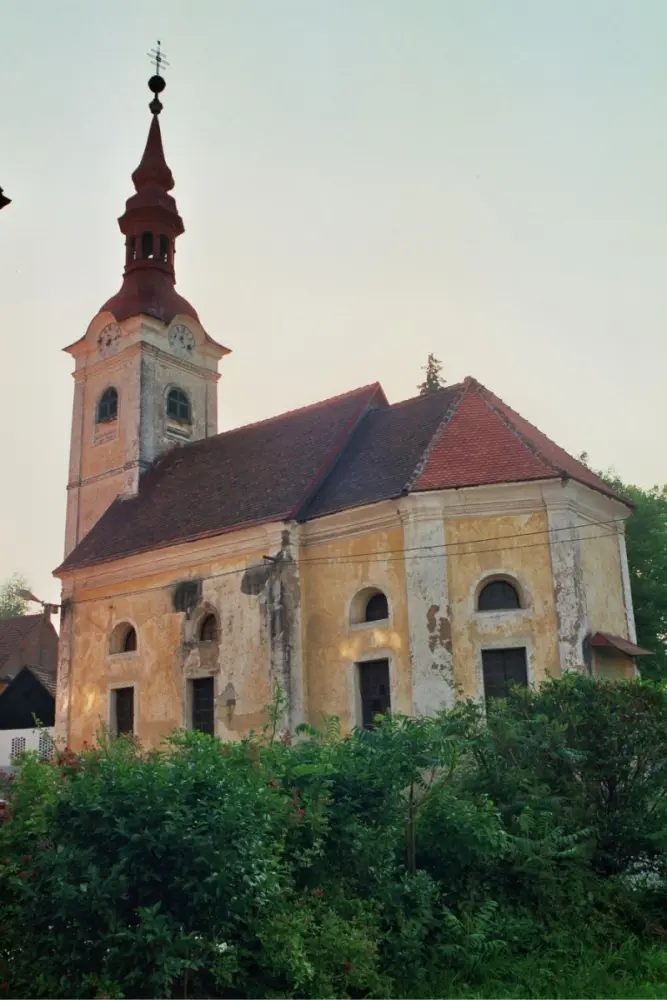
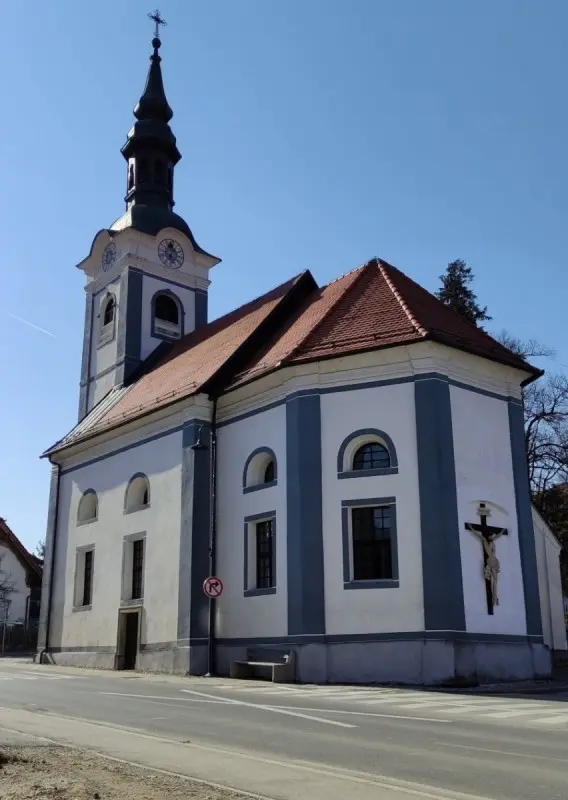
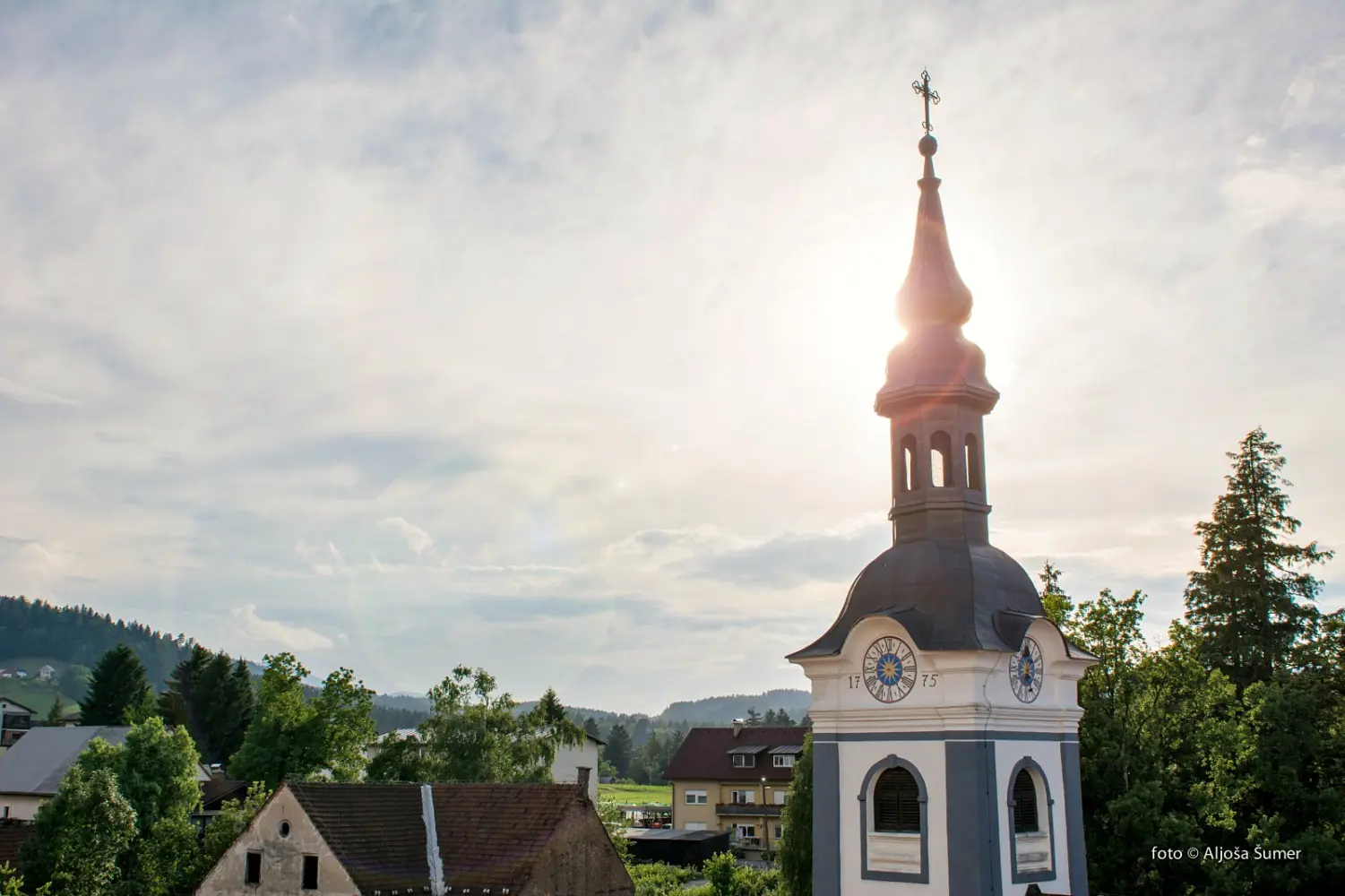
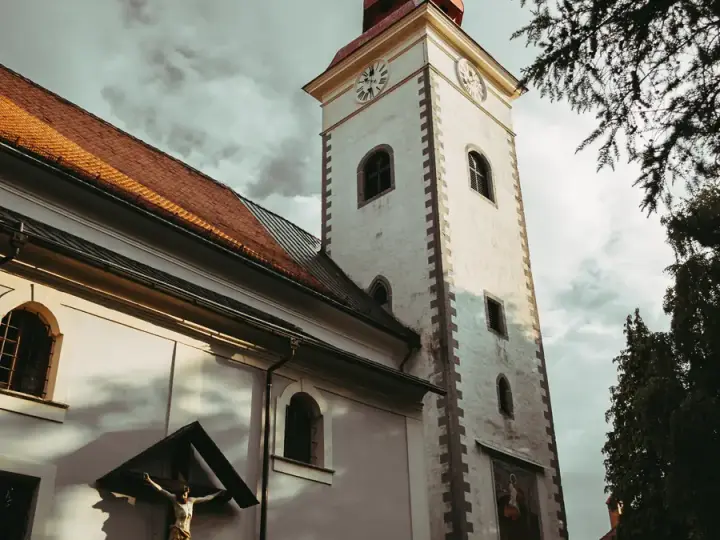
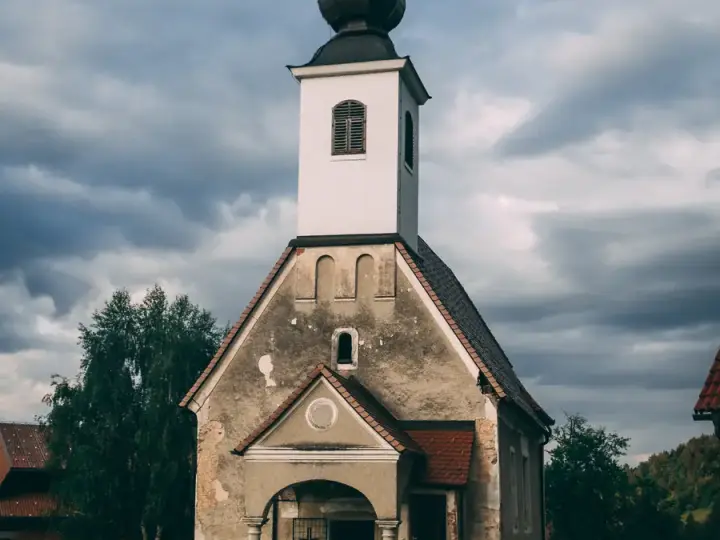
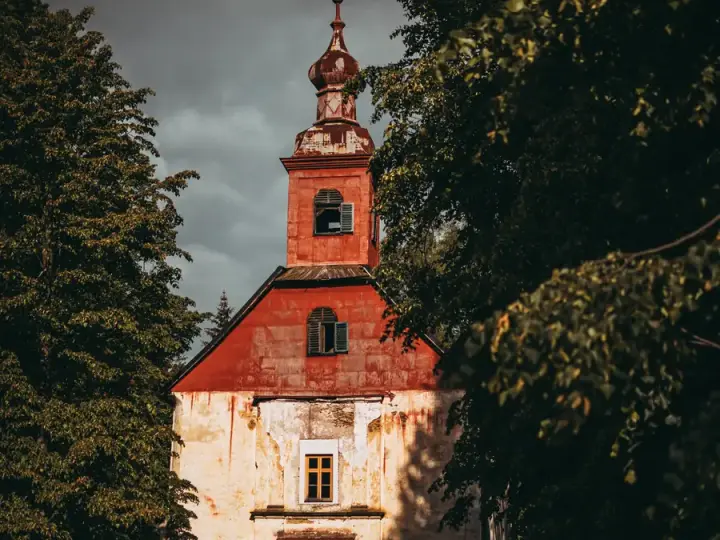
The first mention of this church dates back to 1389, while its present architecture dates from 1659.
The bell tower and sacristy were added later.
On the end wall of the presbytery there is the remnant of a fresco of Mary and John the Evangelist, and in the middle hangs a large, finely crafted Baroque crucifix.
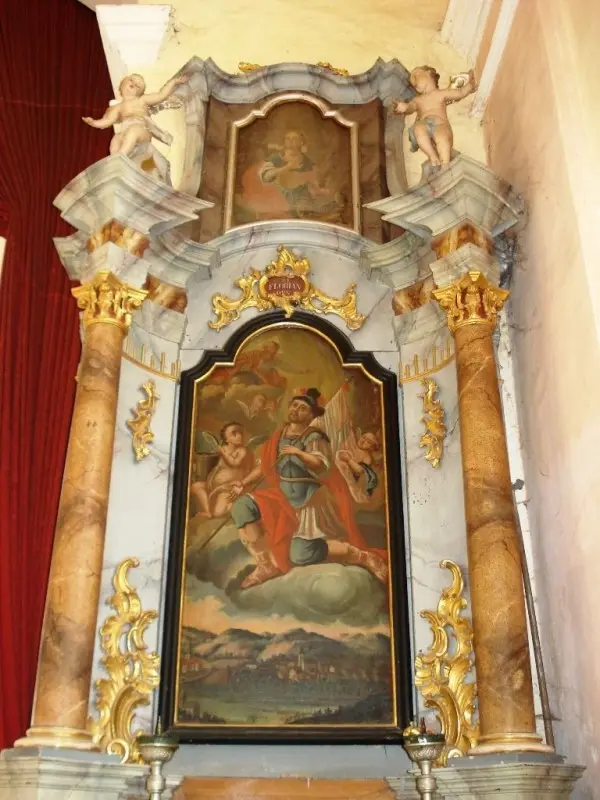
The church also has an altar of St Florian bearing the first pictorial depiction of the town, dating from 1776; the townspeople often turned to St Florian for help against fire.
History of the church
The Church of the Holy Cross is first mentioned in a charter of 13 December 1389, by which Nikolaj Rotenperger (Nikel de Rotenperger) bequeathed to the parish of Lovrenc and the monastery of St Paul all his estates at St Lawrence in Kot (in dem Winchel ze sand Lorentzen). The benefice funded an early morning mass in the Chapel of the Holy Cross (heiligen chreutz), while on Sundays and major church feasts a mass was said for the deceased and his relatives at the altar of St Catherine in the Parish Church of St Lawrence. On the anniversary of Rotenperger’s death the priests also received gifts of money, and meat and wine were distributed among the poor. The farmers on the farms donated to the parish priest of Lovrenc later came to be known as “Kapeller” – farmers belonging to the chapel.
Architecture of the church
In the 18th century the bell tower was added, with a sheet-metal lantern roof and a gable with a Baroque semicircular top. It is framed by lesenes and divided vertically into three bands.
The façades of the nave and presbytery are divided by a plinth course and an eaves cornice. The windows are rectangular and topped by separate, simple lunettes.
Inside the sacred space, the nave is covered by two groin vaults separated by transverse arches borne by three pairs of Tuscan pilasters. The triumphal arch is articulated and depressed. The sacristy and the three-sided presbytery are covered by a groin vault. The choir loft curves into the space in a convex-concave line on two Tuscan columns and two corbels. The door leading to the sacristy is a simple piece of 18th-century stonework.
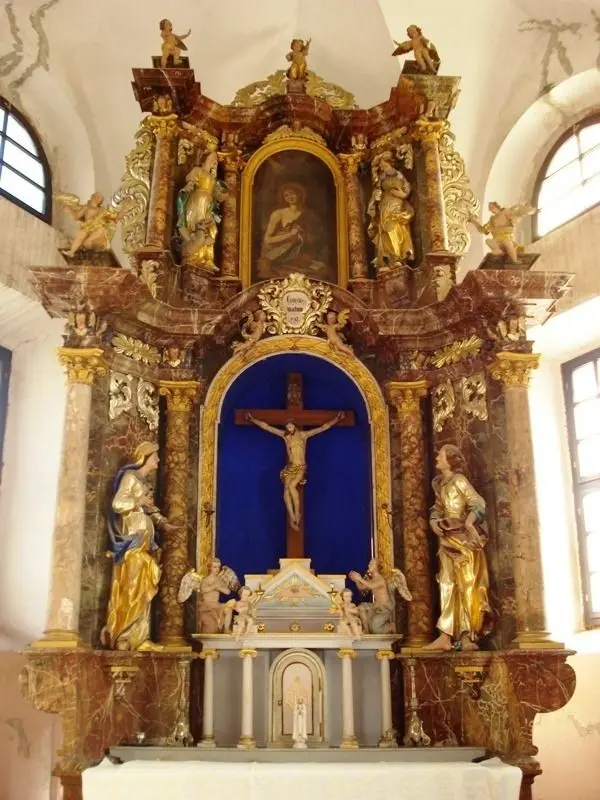
The church has three altars which already “flirt” with the Rococo, the style that followed the Baroque (the period between the Baroque and Neoclassicism). This can be seen in the ornamentation: on the high altar, the design of the retable and the acanthus ornamentation point to the late 17th or early 18th century. In the centre is the Crucified Christ, flanked by the exceptionally slender, Mannerist statues of Mary and St John the Evangelist. The cross in its central niche is more recent, while the cartouche with the inscription “Consummatum est”, held by two putti, is the work of the Konjice master Mihel Pogačnik. He is also credited with the statue of the Crucified Christ that used to hang on the outside of the presbytery.
The most striking feature of the church is the southern side altar, which holds the oldest oil painting of Lovrenc, showing the town as it is believed to have looked in 1776. It depicts St Florian kneeling above a veduta of Lovrenc. The painting is signed “Joseph Göriser Pinx” (painted by Joseph Göriser). The altar itself, in which the painting is set, is Rococo from the mid-18th century, and at its top there is also a Baroque painting of St Margaret.